




Hestia goddess
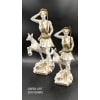
STATUE OF GODDESS HESTIA IN MUSEUM PATINA
Description
STATUE OF GODDESS HESTIA
HANDMADE OF ALABASTER,AND PAINTED IN MUSEUM PATINA.
Hestia is a goddess of the first Olympian generation. She is the eldest daughter of the Titans Rhea and Cronus. And sister to Chiron, Demeter, Hades, Hera, Poseidon, and Zeus. Immediately after their birth, Cronus swallowed all his children (Hestia was the first who was swallowed) except the last and youngest, Zeus. Instead, Zeus forced Cronus to disgorge his siblings and led them in a war against their father and the other Titans.
HESTIA’S IMPORTANCE
Hestia’s name and functions show the hearth’s importance in the social, religious, and political life of ancient Greece. The hearth was essential for warmth, food preparation, and the completion of sacrificial offerings to deities. She was also offered the first and last libations of wine at feasts. Her own sacrificial animal was a domestic pig. Pausanias writes that the Eleans sacrifice first to Hestia and then to other gods. Xenophon in Cyropaedia wrote that Cyrus the Great sacrificed first to Hestia, then to sovereign Zeus, and then to any other god that the magi suggested
The accidental or negligent extinction of a domestic hearth-fire represented a failure of domestic and religious care for the family. Failure to maintain Hestia’s public fire in her temple or shrine was a breach of duty to the broad community. A hearth fire might be deliberately, ritually extinguished at need. And its lighting or relighting should be accompanied by rituals of completion, purification, and renewal. Comparable with the rituals and connotations of an eternal flame and of sanctuary lamps. At the level of the polis, the hearths of Greek colonies and their mother cities were allied and sanctified through Hestia’s cult. Athenaeus, in the Deipnosophistae, writes that in Naucratis the people dined in the Prytaneion on the natal day of Hestia Prytanitis
Dimensions/Weight
| Weight | 0,300 kg |
|---|---|
| Dimensions | 5 × 5 × 17 cm |
| ΚΑΤΗΓΟΡΙΕΣ | K10, K4, K6 |
Related products


STATUES
135,00€


STATUES
90,00€


STATUES
98,00€

STATUES
22,00€


STATUES
138,00€


STATUES
108,00€

STATUES
130,00€

STATUES
360,00€