



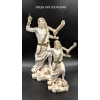


Greek Warrior
24,00€
STATUE OF GREEK WARRIOR IN COLOURED PATINA
2 in stock
Description
Statue of a greek warrior of the phalanx. painted in coloured museum patina.
THE HOPLITE PHALANX
The ancient Greek city-states developed a military formation called the phalanx, which were rows of shoulder-to-shoulder hoplites. The Hoplites would lock their shields together. And the first few ranks of soldiers would project their spears out over the first rank of shields. The Phalanx therefore presented a shield wall and a mass of spear points to the enemy.This made frontal assaults much more difficult. It also allowed a higher proportion of the soldiers to be actively engaged in combat at a given time (rather than just those in the front rank).
THE PHALANX FORMED THE CORE OF ANCIENT GREEK MILITARIES.
Because Greek Warrior- hoplites were all protected by their own shield and others’ shields and spears, they were relatively safe . As long as the formation didn’t break. When advancing towards an enemy, the phalanx would break into a run that was sufficient to create momentum but not too much as to lose cohesion.The opposing sides would collide viciously, possibly terrifying many of the hoplites of the front row. The battle would then rely on the valour of the men in the front line. While those in the rear maintained forward pressure on the front ranks with their shields. When in combat, the whole formation would consistently press forward trying to break the enemy formation. Thus, when two phalanx formations engaged, the struggle essentially became a pushing match, in which, as a rule, the deeper phalanx would almost always win, with few recorded exceptions.
When exactly the phalanx was developed is uncertain, but it is thought to have been developed by the Argives in their early clashes with the Spartans. The chigi vase, dated to around 650 BC, is the earliest depiction of a hoplite in full battle array. The hoplite was a well-armed and armored citizen-soldier primarily drawn from the middle classes. Every man had to serve at least two years in the army. They were a force to be reckoned with.
Dimensions/Weight
| Weight | 0,85 kg |
|---|---|
| Dimensions | 27 cm |
Related products


STATUES
138,00€


STATUES
115,00€


STATUES
80,00€

STATUES
22,00€


STATUES
130,00€


STATUES
108,00€

STATUES
105,00€

STATUES
105,00€