





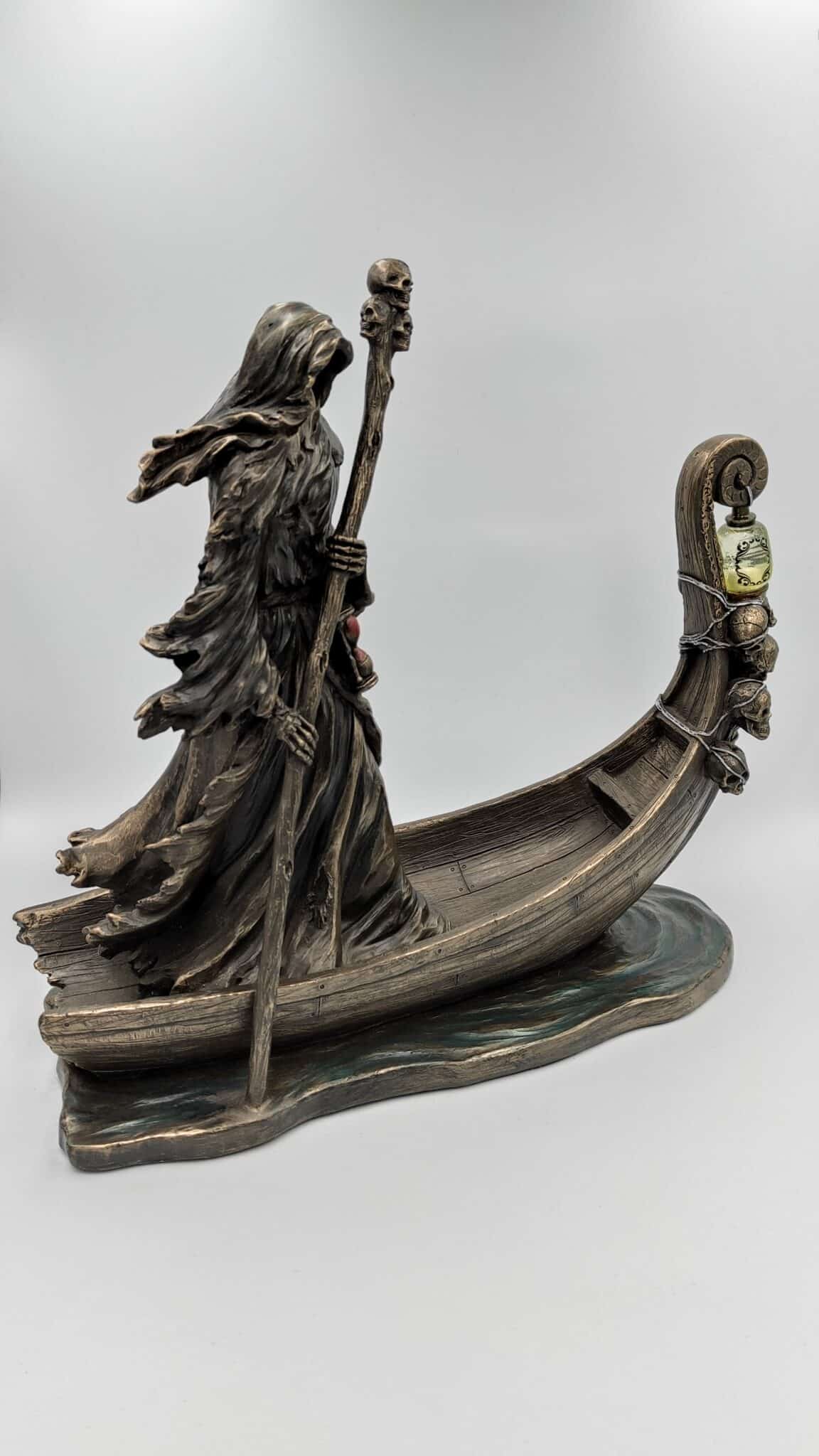

Charon-Thanatos
118,00€
THANATOS-CHARON BY VERONESE DESIGN
2 in stock
Το συγκεκριμένο προϊόν το βλέπουν αυτή τη στιγμή 2 άτομα.
Description
Charon-Thanatos statue.Handmade and metal-coted. Made of cast copper resin, which allows greater detail and a nice weight. All Veronese figurines are beautifully packaged, have great detail and are great collectible gifts
Charon-Thanatos in myth and poetry
The Greek poet Hesiod established in his Theogony that Thánatos is a son of Nyx (Night) and Erebos (Darkness) and twin of Hypnos (Sleep). Homer also confirmed Hypnos and Thanatos as twin brothers in his epic poem, the Iliad. Where they were charged by Zeus via Apollo with the swift delivery of the slain hero Sarpedon to his homeland of Lycia.
Counted among Thanatos’ siblings were other negative personifications such as Geras (Old Age), Oizys (Suffering), Moros (Doom), Apate (Deception), Momus (Blame), Eris (Strife), Nemesis (Retribution) . Thanatos was loosely associated with the three Moirai (for Hesiod, also daughters of Night), particularly Atropos, who was a goddess of death in her own right. He is also occasionally specified as being exclusive to peaceful death, while the bloodthirsty Keres embodied violent death. His duties as a Guide of the Dead were sometimes superseded by Hermes Psychopompos. Conversely, Thanatos may have originated as a mere aspect of Hermes before later becoming distinct from him.
Charon-Thanatos
Thanatos was thus regarded as merciless and indiscriminate, hated by – and hateful towards — mortals and gods alike. But in myths which feature him, Thanatos could occasionally be outwitted. A feat that the sly King Sisyphus of Korinth twice accomplished. When it came time for Sisyphus to die, Zeus ordered Thanatos to chain Sisyphus up in Tartarus. Sisyphus cheated death by tricking Thanatos into his own shackles. Thereby preventing the demise of any mortal while Thanatos was so enchained.
Eventually Ares, the bloodthirsty god of war, grew frustrated. With the battles he incited, since neither side could suffer any casualties. He released Thanatos and handed his captor over to the god. Sisyphus would evade Death a second time by convincing Persephone to allow him to return to his wife stating that she never gave him a proper funeral. This time, Sisyphus was forcefully dragged back to the Underworld by Hermes. Where he was sentenced to an eternity of frustration in Tartarus, rolling a boulder up a hill only to have it roll back down when he got close to the top.
Dimensions/Weight
| Weight | 1,650 kg |
|---|---|
| Dimensions | 26 × 10 × 25 cm |
Related products


STATUES
98,00€

STATUES
138,00€


STATUES
145,00€


STATUES
360,00€

STATUES
105,00€


STATUES
104,00€


STATUES
138,00€


STATUES
96,00€