



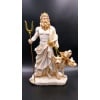

Hephaestus
HANDMADE STATUE OF HEPHAISTOS IN MUSEUM PATINA
Το συγκεκριμένο προϊόν το βλέπουν αυτή τη στιγμή 4 άτομα.
Description
STATUE OF GOD HEPHAISTOS
HANDMADE OF ALABASTER,AND PAINTED IN MUSEUM PATINA.
God Hephaestus was teh Ancient Greek god of fire, metallurgy, and crafts . Hephaistos (Hephaestus) was the brilliant blacksmith of the Olympian gods, for whom he fashioned magnificent houses, armour, and ingenious devices. Hephaistos had his workshop beneath volcanos – Mount Etna on Sicily . Being a favourite haunt – and was, with his lame foot, unique as the only less-than-perfect god. To the Romans, he was known as Vulcan or Volcanus.
Origins & Family
The origins of Hephaistos are obscure . He probably derives from the common idea that early kings should also be masters at certain crafts. Especially metalwork, and perhaps, too, magic (which would have included the manipulation of fire). In Classical Greek mythology, the god was born from Hera and, without a father, Hephaistos was, unlike the other gods, a less than beautiful figure. So much so, that in Greek mythology he is said to have been thrown from the heavens by his mother (or in other accounts by Zeus) because of his ugliness . And landing on the island of Lemnos, the god was crippled. Cared for by Thetis (and possibly also by Eurynome, the daughter of Ocean), he would construct his workshop on the island’s volcano where he lived in an imperishable bright bronze house, where he created his masterpieces of metallurgy.
HIS MARRIAGE WITH APHRODITE
Returning to mythology, Hephaistos married the goddess Aphrodite. The unlikely union occurred as a result of Hephaistos capturing his mother Hera in the invisible chains of a throne he had built. So the wedding was the price of release. The scene is a popular one in Greek art and usually depicts Dionysos leading Hephaistos, under the influence of wine, back to Olympus to free the entrapped Hera. However, the marriage was not to last as Aphrodite had numerous affairs, most notably with the god Ares.
Dimensions/Weight
| Weight | 0,400 kg |
|---|---|
| Dimensions | 9 × 8 × 17 cm |
| ΚΑΤΗΓΟΡΙΕΣ | K10, K4, K6 |
Related products


STATUES
98,00€

STATUES
105,00€


STATUES
130,00€

STATUES
37,00€


STATUES
108,00€

STATUES
105,00€


STATUES
138,00€


STATUES
96,00€