





Cyclop
34,00€
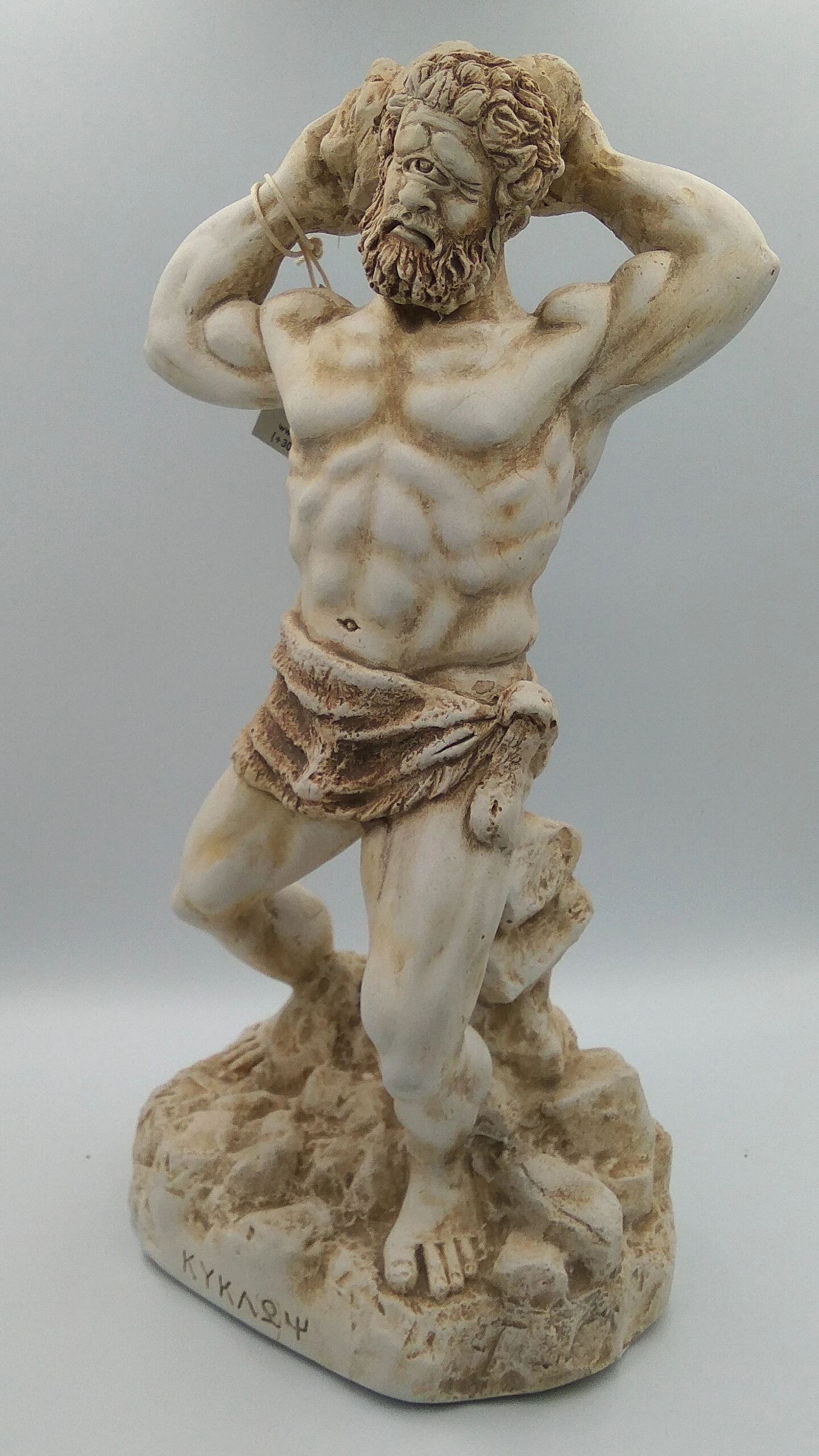
STATUE OF CYCLOP IN COLOURED PATINA
2 in stock
Description
STATUE OF CYCLOP
painted in coloured museum patina.
Cyclop is a giant one-eyed creature In Greek mythology and later Roman mythology, the Cyclopes . Three groups of Cyclopes can be distinguished. In Hesiod’s Theogony, they are the brothers Brontes, Steropes, and Arges, who provided Zeus with his weapon the thunderbolt. In Homer’s Odyssey, they are an uncivilized group of shepherds, the brethren of Polyphemus encountered by Odysseus. Cyclopes were also famous as the builders of the Cyclopean walls of Mycenae and Tiryns.
The fifth-century BC playwright Euripides wrote a satyr play entitled Cyclops, about Odysseus’ encounter with Polyphemus. Mentions of the Hesiodic and the wall-builder Cyclopes also figure in his plays. The third-century BC poet Callimachus makes the Hesiodic Cyclopes the assistants of smith-god Hephaestus. So does Virgil in his Latin epic Aeneid, where he seems to equate the Hesiodic and Homeric Cyclopes
Hesiodic Cyclop
Hesiod, in the Theogony (c. 700 BC), described three Cyclopes: Brontes, Steropes, and Arges, who were the sons of Uranus (Sky) and Gaia (Earth), and the brothers of the Titans and Hundred-Handers, and who had a single eye set in the middle of their foreheads.They made for Zeus his all-powerful thunderbolt, and in so doing, the Cyclopes played a key role in the Greek succession myth, which told how the Titan Cronus overthrew his father Uranus, and how in turn Zeus overthrew Cronus and his fellow Titans, and how Zeus was eventually established as the final and permanent ruler of the cosmos.
The names that Hesiod gives them: Arges (Bright), Brontes (Thunder), and Steropes (Lightning), reflect their fundamental role as thunderbolt makers. As early as the late seventh-century BC, the Cyclopes could be used by the Spartan poet Tyrtaeus to epitomize extraodinary size and strength.The Cyclopes’ prowess as craftsmen is stressed by Hesiod who says “strength and force and contrivances were in their works.” Being such skilled craftsmen of great size and strength, later poets, beginning with the third-century BC poet Callimachus, imagine these Cyclopes, the primordial makers of Zeus’ thunderbolt, becoming the assistants of the smith-god Hephaestus, at his forge in Sicily, underneath Mount Etna
Dimensions/Weight
| Weight | 1,28 kg |
|---|---|
| Dimensions | 28 cm |
Related products
STATUES
116,00€

STATUES
105,00€


STATUES
98,00€

STATUES
118,00€

STATUES
138,00€

STATUES
104,00€

STATUES
22,00€


STATUES
115,00€